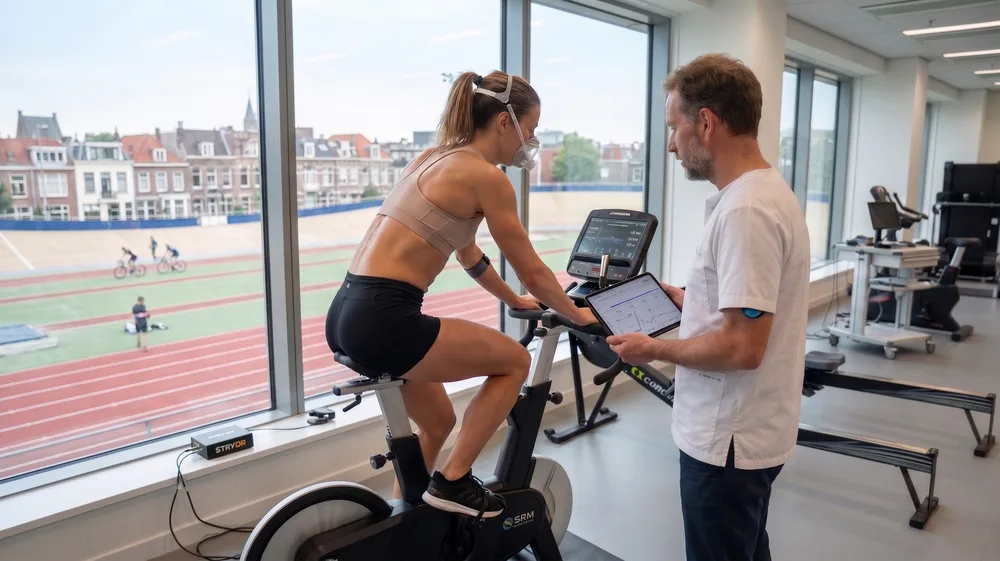
Metabolism
Fitness testing usually stops at VO2max. Metabolism is the rest of the answer: what the body burns at rest, what it burns under load, and where that changes.
The other half of fitness
Cardiorespiratory Fitness asks how much oxygen you can deliver and use at maximal effort. It is the single best-evidenced measure of fitness there is, and it is only half of what breath analysis can tell you.
The other half is metabolic. At rest, how much energy does the body actually burn? Under load, is it burning fat or carbohydrate, and at what intensity does that balance tip? Those answers come from the same analyzer and the same session, and they are the ones that change what a coach or clinician does next week.
All of it comes from measuring gas exchange directly: the oxygen consumed and the carbon dioxide produced, breath by breath, the method known as indirect calorimetry. Nothing here is estimated from heart rate.
Metabolism at rest
Resting metabolic rate is how much energy the body burns doing nothing. It is the baseline that makes every other number interpretable, and it is measured with a resting test, no exercise involved.
What it measures
Resting energy expenditure, what the body burns at rest, from gas exchange while the subject sits still and breathes normally through the analyzer.
Why it matters
Two people of the same age, height and weight can burn measurably different amounts of energy at rest. Assuming a population average instead of measuring it puts every downstream calculation off by that gap.
What you need
A metabolic analyzer. This is the shortest assessment in the set and the least demanding for the subject.
Metabolism under load
As intensity rises, the mix of fuel shifts from fat towards carbohydrate. A sub-maximal ramp test tracks that shift and locates the points that matter, without ever asking the subject for maximal effort.
FatMax
The exercise intensity at which fat oxidation peaks. Useful precisely because it is a measured intensity for this person, not a percentage borrowed from a table.
Substrate utilization
The fat-to-carbohydrate crossover across the intensity range, so training or nutrition can be aimed at a real number.
Ventilatory thresholds
The intensity boundaries that define training zones. Anchored to measured physiology rather than a percentage of maximum heart rate.
Sub-maximal by design
A ramp test that stops short of maximal effort is repeatable more often and suits subjects for whom an all-out test is not appropriate.
Measure it instead of estimating it
See what resting metabolic rate and substrate utilization look like for your own subjects.
SplendoHealth
Guided from setup to report
SplendoMonitor connects over Bluetooth to metabolic analyzers, heart rate and tissue saturation sensors, and ergometers from different manufacturers, then stitches their signals into a single assessment with one timeline and one report.