
Cardiorespiratory Fitness
Cardiorespiratory Fitness, often referred to as CRF, is a measure of the body's ability to effectively transport oxygen to and carbon dioxide from the muscles during prolonged physical activity. It is an essential component of overall fitness and plays a crucial role in maintaining good health.
Understanding the Cardiorespiratory System
The cardiorespiratory system is the lungs, the heart and the blood vessels, working together to deliver oxygen-rich blood to the muscles and carry carbon dioxide away. Any one of the three can be the limit, which is why CRF is worth understanding one stage at a time.
Lungs
The lungs exchange oxygen and carbon dioxide between the air you breathe and your bloodstream. Under exercise they move far more air per minute to keep that exchange up with demand.
Heart
The heart pumps that oxygen on to the organs and the working muscles, and carries waste products back. Under exercise it raises both how fast and how hard it beats.
Muscles
Muscle cells use that oxygen to produce energy. How much of it they can actually extract is what sets how long you hold an effort before fatigue forces you to slow down.
Measuring Cardiorespiratory Fitness
There are four practical ways to put a number on Cardiorespiratory Fitness, and they differ in one important respect: whether they measure oxygen uptake or infer it. A field test like the Cooper Test estimates VO2max from how far someone runs in twelve minutes. A smartwatch estimates it from heart rate. Both are useful starting points and both are estimates.
Direct measurement means capturing the oxygen consumed and the carbon dioxide produced, breath by breath, the method known as indirect calorimetry. That has traditionally required a metabolic cart in a dedicated room, which is why it stayed inside elite sports and clinical research. SplendoMonitor runs the same measurement, with lab-grade accuracy, on sensors that travel.
The table below sets the four side by side, and shows how SplendoHealth makes direct measurement accessible to anyone, anywhere.
| Property | Field test (Cooper) | Smartwatch | Metabolic cart | SplendoHealth |
|---|---|---|---|---|
| How VO2max is obtained | Estimated from distance covered | Estimated from heart rate | Measured from gas exchange | Measured from gas exchange, lab-grade accuracy |
| Breath metrics | None | None | VCO2VentilationRespiratory rateTidal VolumeRER | Breathing TechniqueBreathing EfficiencyVCO2VentilationRespiratory RateTidal VolumeRER |
| Other metabolic data | None | None | RMRFatOx (fat burn rate)CHOOx (carbohydrate burn rate)Thresholds and zones | RMRFatOx (fat burn rate)CHOOx (carbohydrate burn rate)Thresholds and zones |
| Muscle oxygenation | No | No | Not usually | Yes, with a NIRS sensor |
| Reporting | Lookup table | Individual dashboard | Professional interpretation | Automated report with context and recommendations |
| Personnel required | Trainer | No one | Lab technician and physician | Course-trained professional |
| Throughput | 5 per hour | Individual tracking | 1-2 per hour | 10 per hour |
| Where it runs | A track | Anywhere | A dedicated lab | Anywhere |
| Equipment cost | None | Consumer device | Capital equipment | Commercially available, low-cost sensors |
| Effort required | Maximal | Passive | Maximal, or sub-maximal protocols | Maximal, or sub-maximal protocols |
Measure CRF directly
See what direct gas exchange looks like next to a smartwatch estimate for the same person.
SplendoHealth
Guided from setup to report
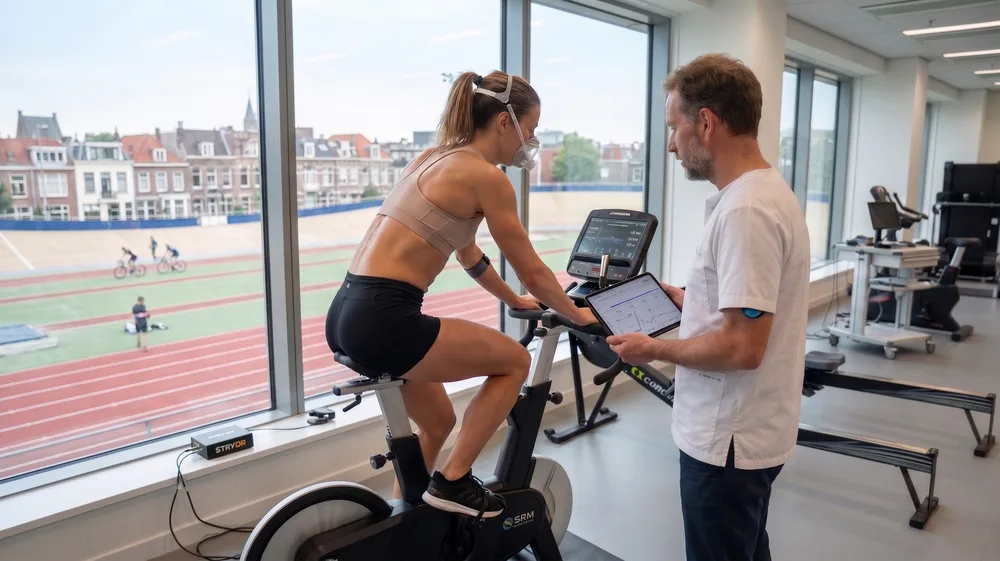
SplendoMonitor connects over Bluetooth to metabolic analyzers, heart rate and tissue saturation sensors, and ergometers from different manufacturers, then stitches their signals into a single assessment with one timeline and one report.



Benefits of Healthy Cardiorespiratory Fitness
Regular aerobic exercise raises Cardiorespiratory Fitness, and a higher CRF is associated with each of the benefits below.
Improved Heart Health
Regular cardiovascular exercise strengthens the heart muscle, enhances its efficiency, and lowers the risk of cardiovascular diseases.
Increased Stamina and Endurance
A higher CRF lets you hold an effort for longer before fatigue sets in, whether in training, at work or in everyday activity.
Weight Management
Aerobic training raises daily energy expenditure, what the body burns in a day, and shifts how much of that comes from fat, which makes body weight easier to manage.
Reduced Risk of Chronic Diseases
A higher CRF is associated with a lower incidence of chronic conditions, including type 2 diabetes and high blood pressure.
Enhanced Mental Well-being
Aerobic exercise releases endorphins, and is associated with better mood and lower perceived stress.

Improving Cardiorespiratory Fitness
Several strategies raise Cardiorespiratory Fitness, and they all work on the same three things: a stronger heart, more usable lung capacity, and muscles that extract oxygen more efficiently. Combining them works better than any one alone, and keeps training varied. Together they are what move the benefits above.
Aerobic Exercises
Running, swimming and cycling, held at a steady effort. This is the base: it strengthens the heart, uses more of your lung capacity, and trains the muscles to extract oxygen efficiently.
Interval Training
Alternating hard efforts with rest or easy work. Intervals raise Cardiorespiratory Fitness quickly, and push at the ceiling that steady training builds toward.
Circuit Training
A sequence of exercises with minimal rest between them, which keeps heart rate elevated throughout and builds cardiovascular fitness alongside strength.
SplendoMonitor is a Cardiorespiratory & Metabolic fitness assessment tool. It is not a certified medical device and is not intended for diagnosing, treating, or monitoring medical conditions.